Indwelling urinary catheters require regular cleaning and may require instillation or irrigation to make sure they are working properly. Find out how to care for your child's catheter at home.
Key points
A urinary catheter is a thin tube that drains urine (pee) from the bladder to the outside of the body.
An indwelling urinary catheter has a balloon that holds the tube in place within the bladder wall.
The bladder may need to be instilled (one-way flush) or irrigated (flushed and pulled back) with a salt-water mixture through the catheter. Instillation and irrigation are ways to help keep urine flowing freely through the catheter.
Go to the Emergency Department if your child has a fever, has blood in their urine, their catheter is accidentally removed or if there is still an obstruction of the catheter after irrigation.
Introduction
Your child has come home from the hospital with an indwelling urinary catheter. A urinary catheter is a thin tube that drains urine (pee) from your child's bladder to the outside of the body. An indwelling urinary catheter has a balloon that holds the tube in place within the bladder wall.
There are some things you need to do to look after your child's catheter at home. Parents and older children can learn how to care for a catheter. Before your child goes home, a member of their health-care team will show you and your child what to do. This page also explains what to do.
There are different types of indwelling urinary catheters:
A Foley catheter enters your child's bladder through the urethra (the tube that carries urine out of the body).
A suprapubic catheter enters your child's bladder through a surgical cut in the abdomen.
How to care for the catheter
Make sure your child is well hydrated and drinking the amount of fluids recommended by their health-care team.
Wash your hands with soap and water before and after you touch the catheter or urine.
Check the catheter tubing every hour for leaks, loops or kinks. Always keep the catheter drainage bag lower than your child's bladder.
Make sure there is an adherence device or tape to hold the catheter in place. The type of device will differ based on your child’s age. You will be shown how to do this before your child leaves the hospital.
Never try to take the catheter out or put it back in by yourself, if you have not been directed to do so.
For children who have not yet learned how to use the toilet, use the double diaper method: two diapers worn at once. The inner diaper is for stool and the outer diaper is for urine. The end of the catheter should be placed in the outer diaper.
For children who have learned to use the toilet, the end of the catheter should be connected to a leg bag (during the daytime) or regular large drainage bag (overnight).
Empty the drainage bag when it is half- to two-thirds full.
Drainage bags should be changed at minimum once per week or when it is appearing cloudy.
Clean your child's skin around the catheter every day with soap and water or cleansing wipes.
Avoid activities that may result in accidental removal of the catheter. Go to the Emergency Department right away if the catheter is accidentally removed, especially if you see blood when the catheter is removed.
Make sure the catheter balloon is filled to the prescribed volume.
Give your child all of their medicine exactly as prescribed by their health-care provider.
You may be instructed to instill (one-way flush) or irrigate (flush in and pull back out) a salt-water mixture called normal saline into your child’s bladder as directed by their health-care provider.
Bladder irrigation and instillation
Bladder instillation or irrigation may be recommended to:
help clear mucus or debris from the bladder
ensure good urine drainage through the catheter
prevent catheter blockage.
These procedures are often done at home after you have been taught by your child’s health-care team. Your child's health-care team will let you know how often to irrigate/instill the bladder and with how much saline solution.
What is bladder irrigation?
Bladder irrigation is a procedure used to gently flush and drain the bladder using normal saline. The normal saline is pushed through your child’s urinary catheter to enter their bladder through the urethra. The solution is then pulled back through a syringe and discarded. This is repeated until the urine in the syringe comes back clear.
Bladder instillation is a procedure used to gently flush the bladder using normal saline. The normal saline is pushed through your child’s urinary catheter to enter their bladder through the urethra. The solution is then drained into a toilet, diaper or drainage bag.
For steps on how to instill normal saline into your child’s bladder, see the instructions below.
Preparing for the treatment
Bladder instillation: What supplies do I need?
You will need the following supplies each time you instill your child's bladder:
Normal saline (0.9% saline)
A sterile container
One 50 mL catheter-tip syringe
Alcohol wipes
Catheter drainage bag (optional)
Can I buy or make normal saline solution?
It is recommended that you use 0.9% normal saline for the purpose of bladder instillations. You can purchase medical grade normal saline or make your own at home.
Medical grade
You can purchase medical grade normal saline from a pharmacy.
To keep sterile, bottles should be one-time use only.
Homemade
You can make normal saline using table salt and boiled or distilled water.
Store in the fridge for one day if made with boiled water.
Store in the fridge for one month if made with distilled water.
How to make a saline solution at home
Saline solution is easy to make at home. Always wash your hands with soap and water before preparing saline at home.
You will need:
one clean, air-tight glass bottle or jar with lid
pot with lid
water
table salt
Instructions
Making a small-volume batch:
Put 1 cup (250 mL) of tap water into a pot and boil for 15 minutes with the lid on.
Remove from heat and cool until the water reaches room temperature.
Add ½ teaspoon of salt into the pot and stir to dissolve.
Carefully pour the salt-water solution from the pot into the jar or bottle and put the lid on.
Refrigerate solution and use within 24 hours.
Making a large-volume batch:
Option 1 (boiling water)
Put 4 cups (1 L) of tap water into a pot and boil for 15 minutes with the lid on.
Remove from heat and cool until the water reaches room temperature.
Add 2 teaspoons of salt into the pot and stir to dissolve.
Carefully pour the solution from the pot into the jar or bottle and put the lid on.
Refrigerate solution and use within 24 hours.
Option #2 (distilled water)
You can used distilled water purchased from most pharmacies and grocery stores to make sterile and longer-lasting saline without boiling water. This is an easy and less time-consuming process.
Mix 8 teaspoons of salt into 4 L of distilled water.
Refrigerate solution and use within one month.
Aseptic non-touch technique (ANTT)
The aseptic non-touch technique (ANTT) is used for bladder instillation. This technique will help to prevent introducing germs, which may cause or worsen an infection in the bladder.
To prevent germs from entering your child’s bladder, key parts and key sites need to be cleaned properly and not touched. Key parts include the tips of syringes and the end of the catheter drainage bag. Key sites include the end of the urinary catheter where the urine exists the bladder. It is important to keep these areas and the overall work environment clean. Use wipeable surfaces to place irrigation supplies and scrub the end of the catheter with an alcohol wipe for 15 seconds and let dry for 15 seconds before attaching anything to the catheter. It is strongly recommended to have two caregivers present to maintain ANTT during bladder installation.
Treatment
Steps for performing bladder instillation
Preparing supplies for the instillation
Wash your hands and gather the supplies you will need on a clean work surface.
Measure out the prescribed amount of 0.9% normal saline that you will need for instillation into a sterile container.
Remove the syringe cap. Draw up the normal saline from the sterile container into the catheter tip syringe. Do not let the tip of the syringe touch anything else.
Remove any air from the catheter tip syringe by tapping the side of the syringe with your finger and gently pushing the air bubbles back into the container with the plunger. Replace the cap on the syringe and set it aside.
Emptying your child’s bladder
Your child’s bladder needs to be empty of urine before starting instillation. Ensure that the indwelling catheter is open to the toilet, a diaper or a drainage bag before completing the next steps.
Performing bladder instillation
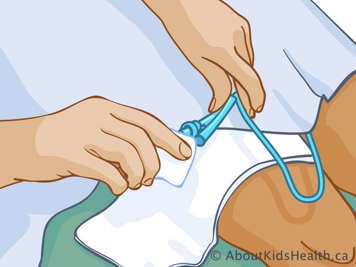
Pinch the end of the catheter between your thumb and forefinger and clean the tip with an alcohol wipe for 15 seconds. Let dry for 15 seconds.
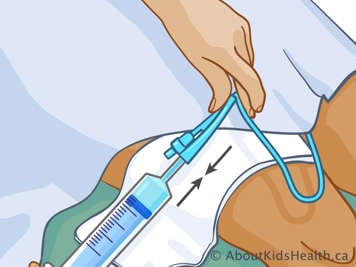
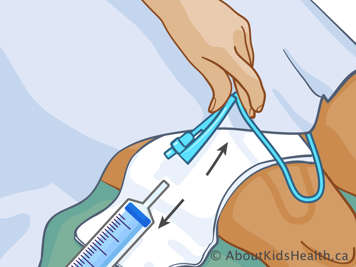
Remove the cap from the syringe of normal saline, then attach the syringe to the end of the catheter.
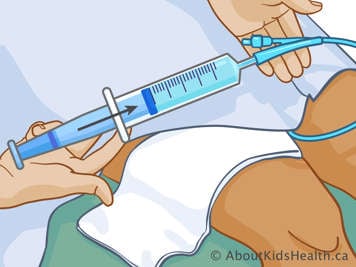
Gently push the plunger so all the normal saline flows through the catheter.
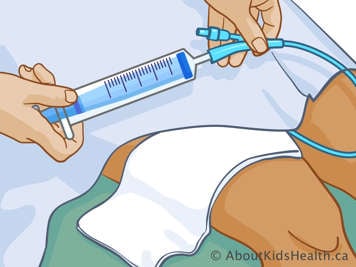
Once the normal saline is all in, pinch the catheter and remove the syringe. Let the saline solution drain from your child’s bladder over a toilet, into a diaper or into a drainage bag.
a. If you are reconnecting to a drainage bag, clean the end of the catheter and the tip of the drainage bag tubing with an alcohol wipe before connecting them (scrub for 15 seconds, then let dry for 15 seconds).
b. If you are draining into a toilet or placing the catheter tip back into a double diaper, cleaning the tip with an alcohol wipe is not required.
After the treatment
Can I reuse any of the supplies?
Urinary catheters and alcohol wipes are single use items only. This is to limit the risk of recurrent urinary tract infections (UTIs).
The standard of practice is to discard catheters after one use. Sterilizing and re-using catheters is not recommended. It can significantly increase a child’s risk of urinary tract infection. If you choose to reuse catheters, please discuss ways of reducing the risk to your child with the health-care team.
Normal saline made at home can be kept in the fridge for one day or one month, depending on how it was prepared. Ensure the lid is closed before storing. Be careful not to contaminate the container by touching or putting anything inside. Normal saline should be poured out of the container, not scooped or ladled out.
Catheter caps, specimen containers and catheter tip syringes can be sterilized and re-used for up to seven days.
Cleaning catheter caps, catheter tip syringes and containers
Catheter caps, catheter tip syringes and specimen containers should be cleaned immediately after use.
Just after using the supplies, take the syringe pieces apart and wash all the items with warm water and dish soap. Rinse thoroughly two times.
Dry with paper towel and store in a plastic bag. Sterilize them later that day as outlined below.
Sterilizing catheter caps, catheter tip syringes and containers
Soak containers and syringes in a clean basin of room temperature water with 1 cup of vinegar for about 30 minutes.
Rinse containers and syringes with distilled water.
You can boil water and have it return to room temperature before using, or you can use bottled distilled water to rinse the containers. Do not use boiling hot water on these items.
Put the items on a clean paper towel to air dry completely. Store the items in a clean zip-lock plastic bag.
Helping your child
Will my child receive home care after discharge?
Your child’s health-care team may submit a referral for home care nursing if there is an anticipated need to support your child’s care at home. This is usually a temporary service. A hospital care coordinator will review the referral to determine if home care services are an option for your child and may contact you for more information. They will work with your local home care office to coordinate services and supplies if appropriate.
How can I make my child more comfortable?
Have your child sitting down during the instillation procedure.
Giving the normal saline at cooler temperatures or too quickly can cause painful bladder spasms. These can be avoided by bringing the normal saline to room temperature and by pushing the plunger slowly when administering the solution. You can bring the solution to room temperature by either leaving the solution out in a sealed container to gradually reach room temperature or warming it within the sterile container under warm tap water.
Push the syringe of normal saline slowly to prevent bladder spasms.
When to seek medical attention
When to seek medical attention
Go to the nearest Emergency Department if:
your child has a fever greater than 38°C (100.4°F)
the catheter is accidentally removed and you have not been taught how to or instructed not to reinsert it
the catheter continues to stay blocked after irrigating it
there is blood in your child’s urine, especially if you see bright red or clots.
Call your child's surgeon or the urology resident on call if:
there is much less urine than usual draining from the catheter. Normally, there should be a slow, steady flow.
if you notice a change in the colour of your child's urine.
At SickKids
At SickKids
For urgent concerns after hours or on weekends, please consult your child’s primary care provider, visit your local Emergency Room or the SickKids Emergency Unit.
Your child’s health-care team can help you choose the right supplies and can provide you with a prescription for your child’s supplies to submit to private insurance for coverage.